
Do all cryptocurrencies use blockchain
Under this system, the code has essentially created the coins. All that’s left is to distribute them. This is done through coin mining. As you might already know, coin mining is the process of verifying transactions and building blocks in Bitcoin’s blockchain https://wedoweb.org/table-games/baccarat/free/. Miners are rewarded for the work they do with new coins.
New cryptocurrencies are created by developers using open-source blockchain code. They often launch through token generation events or blockchain forks. Some are built for specific applications like gaming or governance, while others aim to improve existing systems. Innovation in the space leads to constant emergence of new crypto types.
However, this does not mean that altcoins are interchangeable with each other. Quite the opposite. Altcoins are all built on the same basic framework as bitcoin and share some of bitcoin’s basic characteristics, and altcoins can all be traded like bitcoin, but each one is distinct. For example, one major altcoin, Ethereum, is minable, but altcoins like Stellar are not.
Are all cryptocurrencies mined
Last but not least, significant changes may happen at the protocol level. For example, the halving of Bitcoin can affect mining profitability as it cuts the reward for mining a block in half. In other cases, the process of mining can be replaced by other validation methods. For example, Ethereum switched completely from the PoW to the Proof of Stake (PoS) consensus mechanism in September 2022, which made mining unnecessary.
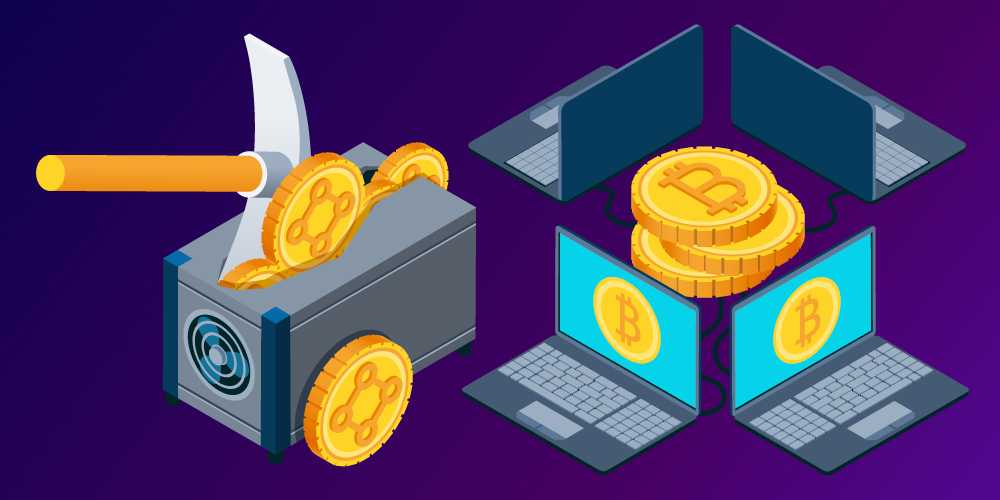
Last but not least, significant changes may happen at the protocol level. For example, the halving of Bitcoin can affect mining profitability as it cuts the reward for mining a block in half. In other cases, the process of mining can be replaced by other validation methods. For example, Ethereum switched completely from the PoW to the Proof of Stake (PoS) consensus mechanism in September 2022, which made mining unnecessary.
At this point, the candidate block becomes a confirmed block, and all miners move on to mine the next block. Miners who couldn’t find a valid hash on time discard their candidate block as a new mining race starts.
It’s important to note that Bitcoin mining hardware can be expensive, loud, generate heat, and consume a significant amount of electricity. You should keep these factors in mind if you’re planning to set up mining hardware in your home.
Though they are, by name, opposites, the purpose of mined and non-mined cryptocurrency is the same: validation. Ultimately, each transaction processed over a blockchain network needs to be verified by someone to ensure that the same virtual token wasn’t spent twice. In effect, it describes the process of proofing a transaction to make sure it’s true. A group of transactions is considered to be part of a “block,” and when a block of transactions has been validated, it joins the previously validated blocks to create a chain of true transactions, or a “blockchain.”
“Overall, mining has become less a game of experimentation and more a capital-intensive business, with economies of scale playing a central role — just as in traditional commodity extraction industries,” Earle added.
Value of all cryptocurrencies
A cryptocurrency is a decentralized digital currency. It’s called cryptocurrency because all transactions are protected by cryptography. However, the revolutionary with cryptocurrencies is the blockchain technology. This makes them completely decentralized. In other words, there is no bank, company or intermediary. By removing all middlemen you avoid expensive fees, long waiting times and the need to trust a third party. With cryptocurrency, you send money faster, cheaper and easier.
The very first cryptocurrency was Bitcoin. Since it is open source, it is possible for other people to use the majority of the code, make a few changes and then launch their own separate currency. Many people have done exactly this. Some of these coins are very similar to Bitcoin, with just one or two amended features (such as Litecoin), while others are very different, with varying models of security, issuance and governance. However, they all share the same moniker — every coin issued after Bitcoin is considered to be an altcoin.
The total crypto market volume over the last 24 hours is $172.65B, which makes a 34.94% increase. The total volume in DeFi is currently $27.22B, 15.77% of the total crypto market 24-hour volume. The volume of all stable coins is now $161.34B, which is 93.45% of the total crypto market 24-hour volume.
Coinlore Independent Cryptocurrency Research Platform: We offer a wide range of metrics including live prices, market cap, trading volumes, historical prices, yearly price history, charts, exchange information, buying guides, crypto wallets, ICO data, converter, news, and price predictions for both short and long-term periods. Coinlore aggregates data from multiple sources to ensure comprehensive coverage of all relevant information and events. Additionally, we provide APIs and widgets for developers and enterprise users.
All cryptocurrencies
One of the biggest winners is Axie Infinity — a Pokémon-inspired game where players collect Axies (NFTs of digital pets), breed and battle them against other players to earn Smooth Love Potion (SLP) — the in-game reward token. This game was extremely popular in developing countries like The Philippines, due to the level of income they could earn. Players in the Philippines can check the price of SLP to PHP today directly on CoinMarketCap.
Cryptocurrencies are digital assets that are secured by cryptography. They use decentralized networks to transfer and store value, and the transactions are recorded in a publicly distributed ledger known as the blockchain. Transactions are verified by network nodes and recorded in a public distributed ledger known as the blockchain. Cryptocurrency transactions are secure, and are verified by a decentralized network of computers.
Cryptocurrency market capitalization (market cap) refers to the total value of a particular cryptocurrency that is currently in circulation. It is calculated by multiplying the current market price of a cryptocurrency by the total number of coins or tokens that have been issued. The total market capitalization of all cryptocurrencies for today is $3,483,735,942,412
The UK’s Financial Conduct Authority estimated there were over 20,000 different cryptocurrencies by the start of 2023, although many of these were no longer traded and would never grow to a significant size.
Play-to-earn (P2E) games, also known as GameFi, has emerged as an extremely popular category in the crypto space. It combines non-fungible tokens (NFT), in-game crypto tokens, decentralized finance (DeFi) elements and sometimes even metaverse applications. Players have an opportunity to generate revenue by giving their time (and sometimes capital) and playing these games.